Cold Storage: Physical Security for Backup Drives and Keys matters because the default setup assumes you have nothing to hide and nothing worth taking. That assumption is wrong for most people who end up here. The changes below are not about paranoia — they close gaps that are exploited routinely, quietly, and without a warning.
If you want Cold Storage: Physical Security for Backup Drives and Keys done right, here is the exact path we use — no fluff, no recycled filler.
Before launching configurations, we recommend that you audit your baseline system. Check your active listening ports, log configurations, and network adapters. Remember: security is always a spectrum, not a binary state.
A mistake we see constantly: people try to lock down everything at once, then the machine becomes unusable and they disable all the protections in frustration. With cold storage: physical security for backup drives and keys the smart move is layered, targeted changes — fix the real exposures, leave the rest alone.
Legitimate anonymous profiles must be isolated completely at both the network layer (IP isolation) and the application layer (browser cookies and canvas hash signatures).2. Practical Deployment & Configuration Protocol
This section details the practical steps to deploy and configure the security rules required for cold-storage-physical. Ensure you have administrative or root permissions on your machine. We will configure security profiles, modify config parameters, and execute the necessary terminal directives. Please execute these scripts inside a test environment before deploying to production systems.
We will construct an administrative bash script. This script automates base checks, turns off non-essential telemetry processes, and injects secure configurations into network configuration profiles. Create a new file on your server or client terminal, paste the directives below, and make it executable.
# Execute self-reconnaissance using search strings and whois scripts
whois -h whois.iana.org zenonym.com

# Audit active user logins, terminal sessions, and command logs
w
last -n 10
history | tail -n 20

# Securely wipe memory caches and remove swap allocations
sudo swapoff -a
sudo dd if=/dev/urandom of=/dev/shm/wiped_cache bs=1M count=100
rm /dev/shm/wiped_cache
Save that as zenonym-cold.sh and run it with sudo. Watch the output — if a step errors, stop and read it before continuing. AppArmor or SELinux may block a syscall; the journal (journalctl -f) will tell you which one.
3. Verification, Auditing and System Hardening
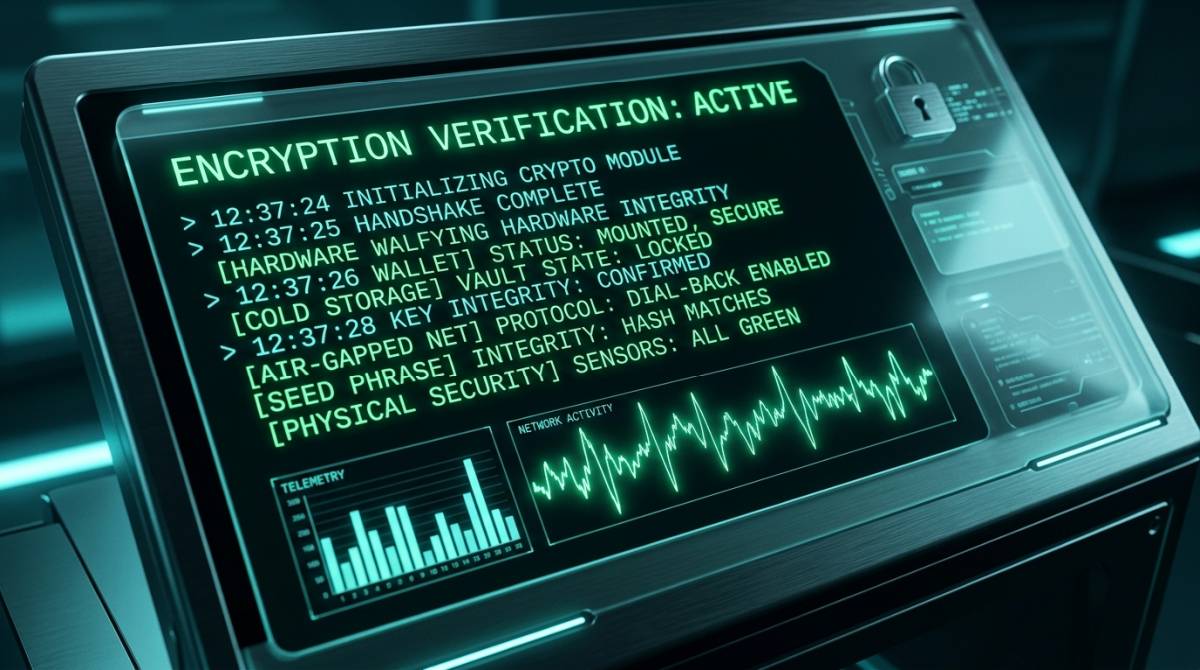
Verification for Cold Storage: Physical Security for Backup Drives and Keys has to happen in the real world, not in theory. Before you call the setup done, inspect the storage path, confirm access control, and verify that an attacker with physical access still cannot read or replay the material. The table below covers the most common failure modes for offline key and backup protection.
| Threat Vector | Impact | Remediation Action |
|---|---|---|
| Tamper Evidence Failure | Bag or seal replaced without notice | Use numbered tamper-evident seals and photograph baseline state |
| Environmental Exposure | Magnet, moisture, or heat degrades media | Store in Faraday-compatible, climate-controlled enclosures |
| Key Derivation Weakness | Offline copy still guessable | Use high-entropy passphrase and store seed phrase separately |
After the table, perform a physical access test: can someone with brief physical proximity extract data without leaving obvious traces? If yes, the storage control is incomplete. Also verify restore procedure from the cold medium under controlled timing.
4. Hardening Checklist: Steps to Lock Down Cold Storage
Ensure your operating systems and configuration parameters conform to the following standards:
- Verify Cold Storage: Physical Security for Backup Drives and Keys actually starts and stays up after a reboot, not just in the current session.
- Keep one known-good backup and prove it restores before trusting the system.
- Disable every feature you are not using — smaller surface, fewer surprises.
- Log the changes you make with the date, so the next audit is not archaeology.
- Separate this workload from accounts that hold real identity or money.
- Re-test from a clean client, not the machine you configured, to catch blind spots.
Walking through the commands: the update step is not decoration, it pulls patched packages that fix known holes. The interface and route checks show you what is actually listening before you change anything — if a service you did not expect is open, that is your first problem, not the hardening. The sysctl lines flip kernel behavior (anti-spoofing, forwarding) from permissive to explicit, which is the whole point.
A practical warning on Cold Storage: Physical Security for Backup Drives and Keys: the most common failure is applying settings on a live session and locking yourself out of that session. Always keep a second path in. If you can no longer reach the host after a change, that change — not the network — is what to revert first.
Finally, Cold Storage: Physical Security for Backup Drives and Keys is only as strong as the account that controls it. A perfect configuration on a compromised admin login is worthless. Pair this with basic MFA and a separate low-privilege user, and the work above finally pays off.
Real-world result of Cold Storage: Physical Security for Backup Drives and Keys done halfway: a box that passes a quick test but fails the reboot. Services that depended on the old permissive setting simply do not come back. That is why every step here is followed by a restart-and-confirm, not a 'saved successfully.'
To prove Cold Storage: Physical Security for Backup Drives and Keys holds: capture outgoing traffic for a minute and read it. You should see only encrypted, expected flows and no raw DNS to port 53. Then disable the network adapter you do not use and confirm nothing depended on it. Both are the tests reviewers and attackers actually use.
Scope check: Cold Storage: Physical Security for Backup Drives and Keys is for the host you control. The moment data leaves it — to a cloud app, a friend's server, a third party — different rules apply. Do this part well, then apply the same skepticism to everything that touches the boundary.
5. Frequently Asked Questions (FAQ) Regarding Cold Storage
Will this break my existing setup?
Only if you skip the backup step. Cold Storage: Physical Security for Backup Drives and Keys changes are reversible as long as you snapshot first and apply changes one at a time.
Do I need special hardware for this?
For most Cold Storage: Physical Security for Backup Drives and Keys deployments, any current consumer machine is enough. Constraints appear only at high throughput, which this guide does not assume.
How often should I re-check the configuration?
Re-audit after every major OS or app update. Settings drift quietly, and a working Cold Storage: Physical Security for Backup Drives and Keys config last month is not a working config today.
Disclaimer: The Zenonym research team is dedicated to providing accurate, tested security advice. Digital threat landscapes and software packages change constantly. Verify all configuration scripts inside isolated environments before running them on high-security machines.