Encrypted Server Name Indication (ESNI): Next Web Privacy Standard is one of those things that looks optional until the day it isn't. The setup is not hard; the discipline to keep it correct is. Treat the steps below as the floor, not the ceiling, and you will be ahead of almost every default configuration in the wild.
We wrote this because most Encrypted Server Name Indication (ESNI): Next Web Privacy Standard tutorials skip the parts that actually break in practice.
Before launching configurations, we recommend that you audit your baseline system. Check your active listening ports, log configurations, and network adapters. Remember: security is always a spectrum, not a binary state.
There is a well-worn failure mode here: maximal locking, immediate friction, total abandonment. For encrypted server name indication (esni): next web privacy standard, aim for controls tight enough to matter and loose enough that you will not silently disable them later.
Legitimate anonymous profiles must be isolated completely at both the network layer (IP isolation) and the application layer (browser cookies and canvas hash signatures).2. Practical Deployment & Configuration Protocol
This section details the practical steps to deploy and configure the security rules required for esni-privacy. Ensure you have administrative or root permissions on your machine. We will configure security profiles, modify config parameters, and execute the necessary terminal directives. Please execute these scripts inside a test environment before deploying to production systems.
We will construct an administrative bash script. This script automates base checks, turns off non-essential telemetry processes, and injects secure configurations into network configuration profiles. Create a new file on your server or client terminal, paste the directives below, and make it executable.
# Preflight for Encrypted Server Name Indication (ESNI): Next Web Privacy Standard
sudo apt-get update && sudo apt-get install -y iproute2 dnsutils curl tcpdump

# Interfaces and routes as they stand now
ip -br addr
ip route

# Kill source spoofing
sudo sysctl -w net.ipv4.conf.default.rp_filter=1

# Quick DNS leak probe
dig +short myip.opendns.com @resolver1.opendns.com
Save that as zenonym-encrypted.sh and run it with sudo. Watch the output — if a step errors, stop and read it before continuing. AppArmor or SELinux may block a syscall; the journal (journalctl -f) will tell you which one.

3. Verification, Auditing and System Hardening
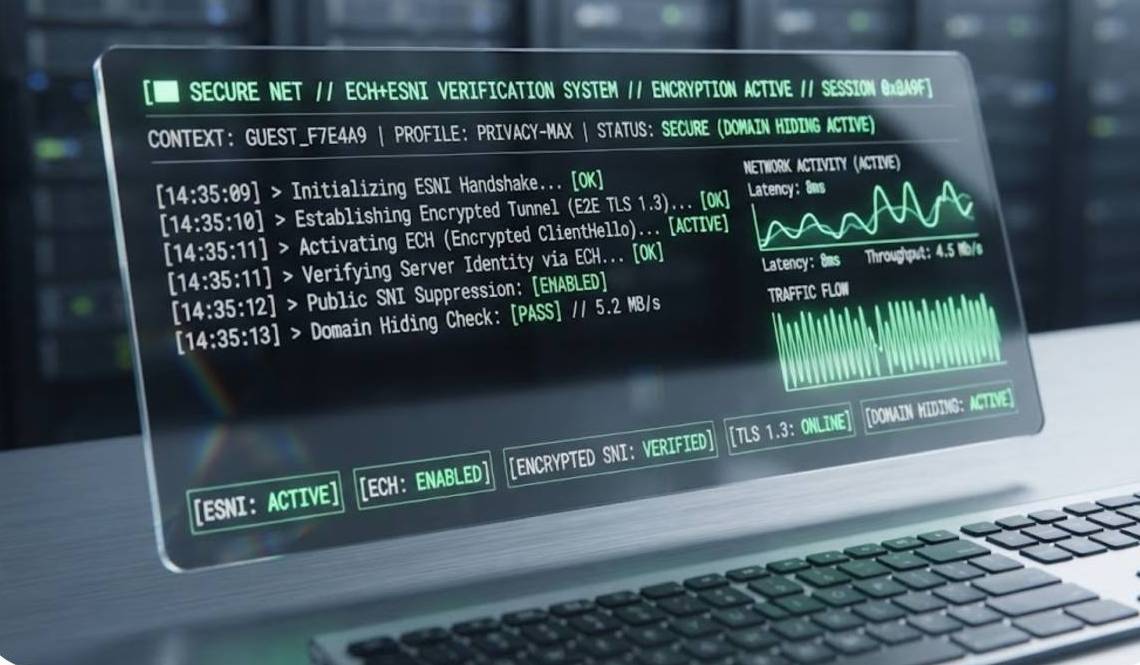
Verification for Encrypted SNI (ESNI/ECH) has to happen on the live TLS handshake path, not in theory. Before you call the setup done, confirm encrypted SNI is negotiated, fallback to plaintext is rejected or flagged, and the client resolver supports ECH end-to-end. The table below covers the most common failure modes in SNI privacy deployment.
| Threat Vector | Impact | Remediation Action |
|---|---|---|
| SNI Plaintext Leak | Domain name visible to network observers | Enable ECH on client and server and confirm encrypted SNI is used |
| Half-Connection Fallback | Server falls back to cleartext SNI silently | Verify fallback behavior and reject connections without valid ECH |
| Client Support Gap | Browser or resolver does not honor ECH | Update client and confirm ECH negotiation succeeds in live connections |
After the table, inspect TLS handshake captures and confirm ECH is present. Test with a resolver that does not support ECH to verify fallback behavior matches your policy. Also check client logs for ECH negotiation failures.
| Threat Vector | Impact | Remediation Action |
|---|---|---|
| DNS Query Leaks | ISP tracks domain history | Force DNS-over-HTTPS in client configuration. |
| IPv6 Bypass routes | Unencrypted traffic escapes tunnel | Disable IPv6 dynamically inside sysctl configuration. |
| Cleartext Handshakes | SNI logs target IP/Host | Enable Encrypted Client Hello (ECH) protocol. |
Then prove it: run a DNS leak test and a WebRTC leak test from a client on the same network. If the result shows your ISP or your real LAN address, the setup is not actually sealing the path — fix that before trusting it.
4. Hardening Checklist: Steps to Lock Down Encrypted Server Name Indication (ESNI)
Ensure your operating systems and configuration parameters conform to the following standards:
- Verify Encrypted Server Name Indication (ESNI): Next Web Privacy Standard actually starts and stays up after a reboot, not just in the current session.
- Keep one known-good backup and prove it restores before trusting the system.
- Disable every feature you are not using — smaller surface, fewer surprises.
- Log the changes you make with the date, so the next audit is not archaeology.
- Separate this workload from accounts that hold real identity or money.
- Re-test from a clean client, not the machine you configured, to catch blind spots.
On the commands: people paste them and move on, then cannot debug later. The interface dump is your baseline — compare it after changes to spot drift. The DNS probe confirms your resolver is the one you chose, not one pushed by the network. The kernel flags are the difference between 'it works' and 'it is actually constrained.'
You will know Encrypted Server Name Indication (ESNI): Next Web Privacy Standard is actually working by testing from outside, not by trusting the config file. A leak test, a port scan from another machine, and a reboot to confirm persistence are the three checks that separate 'saved' from 'done.' Skip any one and you are guessing.
Keep Encrypted Server Name Indication (ESNI): Next Web Privacy Standard boring: documented, tested, and reversible. The setups that survive are the unglamorous ones someone actually wrote down. If you cannot explain why a line is there, it should not be.
Real-world result of Encrypted Server Name Indication (ESNI): Next Web Privacy Standard done halfway: a box that passes a quick test but fails the reboot. Services that depended on the old permissive setting simply do not come back. That is why every step here is followed by a restart-and-confirm, not a 'saved successfully.'
Concrete verification for Encrypted Server Name Indication (ESNI): Next Web Privacy Standard: from a separate machine, run a port scan and confirm only intended ports answer. Open a DNS leak test in the browser you use and confirm the resolver is yours. Reboot and repeat. If any check differs from before, the change did not persist — fix that before calling it done.
Scope check: Encrypted Server Name Indication (ESNI): Next Web Privacy Standard is for the host you control. The moment data leaves it — to a cloud app, a friend's server, a third party — different rules apply. Do this part well, then apply the same skepticism to everything that touches the boundary.
5. Frequently Asked Questions (FAQ) Regarding Encrypted Server Name Indication (ESNI)
Will this break my existing setup?
Only if you skip the backup step. Encrypted Server Name Indication (ESNI): Next Web Privacy Standard changes are reversible as long as you snapshot first and apply changes one at a time.
Do I need special hardware for this?
For most Encrypted Server Name Indication (ESNI): Next Web Privacy Standard deployments, any current consumer machine is enough. Constraints appear only at high throughput, which this guide does not assume.
How often should I re-check the configuration?
Re-audit after every major OS or app update. Settings drift quietly, and a working Encrypted Server Name Indication (ESNI): Next Web Privacy Standard config last month is not a working config today.
Disclaimer: The Zenonym research team is dedicated to providing accurate, tested security advice. Digital threat landscapes and software packages change constantly. Verify all configuration scripts inside isolated environments before running them on high-security machines.